Physical education and health projects as an effective form of interaction between teachers and parents in preschool education
Автор: Воронова Валентина Юрьевна
Организация: МОУ «Тавровская СОШ «Формула Успеха»
Населенный пункт: Белгородская область, г .Белгород
Abstract:This article examines physical education and health projects as a form of interaction between preschool educational organizations (PEO) and families. It substantiates the necessity for parents' active participation in children's physical development activities at the preschool level. Traditional forms of teacher-parent interaction are analyzed along with their potential for organizing joint activities. The author also reveals the content of physical education and health projects and highlights specifics of their implementation within PEOs, defining key stages of collaborative work involving teachers, children, and parents. The author presents projects such as "Sporty Family," "Healthy Daily Routine," and "Healthy Plate" aimed at addressing current challenges in physical education and health promotion, as well as discusses advanced practices of using project-based learning in PEOs.
Keywords: Preschool education; physical education and health activity; physical development; project-based learning; parents of preschoolers; pedagogical interaction.
Introduction Project-based learning in preschool educational organizations allows children to engage in practical exploration of reality. However, due to the developmental characteristics of preschool-aged children, they cannot independently identify problems, formulate goals, or organize activities.2 источника Therefore, a physical education and health project can be considered as a form of cooperation between PEO and family, aimed at jointly solving tasks related to physical development, strengthening health, and fostering interest in motor activity among preschool-age children.
The effectiveness of this interaction is determined by equal participation of both the teacher and parents in the educational process. The teacher defines the objectives and content of the project considering children's age-specific features and family capabilities, while parents participate in its implementation. This ensures continuity of physical education and health activities between the PEO and home environment, creating unified conditions for children's physical development.
On one hand, full-fledged physical development and health improvement require coordinated efforts from both the PEO and the family. On the other hand, traditional forms of teacher-parent interaction do not always ensure their active joint involvement in physical education and health activities. Thus, the research problem lies in determining the possibilities of physical education and health projects as a form of active interaction between teachers and parents.
The goal of the study is to justify physical education and health projects as an effective form of interaction between teachers and parents at the preschool level.
The novelty of the proposed solution consists in suggesting that physical education and health projects should be viewed not merely as isolated events or means of informing parents but rather as a systemic form of interaction between PEO and families.
Main Body
Physical development occupies a significant place in the overall development of preschool-age children. During this period, motor skills are formed, functional readiness of the body increases, and foundations of physical culture and healthy lifestyle are laid down. Consequently, creating conditions for regular motor activity and health improvement must occur not only in preschool educational institutions but also in the family. Consistency between educators' requirements and parental actions provides a unified approach to physical upbringing and helps consolidate acquired skills in everyday life. A crucial role in this process belongs to parents' engagement in physical education and health activities with their children.
Considering the vast potential embedded in the pedagogical interaction between PEO and families, this issue has been addressed by Russian scholars. Significant contributions have been made by O.S. Gazman, N.B. Krylova, N.N. Mikhaylova, who studied the interrelation between parents and educational organizations in the context of pedagogical support for child personality development. I.V. Grebennikov and G.N. Filonov emphasized the need for parents and educators to create favorable conditions for the child's personal growth, moral orientation, and self-determination through joint efforts.
Interaction between educators and parents in PEO constitutes a holistic socio-psychological system combining perceptual (perception), communicative (communication), and interactive (collaboration, co-creation) components. In this system, both the educator and parents act as equal subjects of the educational process.
In PEOs, various forms of teacher-parent interaction during physical education and health activities are used: consultations, conversations, parent meetings. Their advantage lies in accessibility and the ability to reach a large number of parents. However, these forms often have an episodic or predominantly informative character, which does not provide sustained joint participation of the teacher, child, and parents. S.E. Luneva notes that modern kindergarten teachers should abandon so-called "traditional" forms of interaction with families because they are far less demanded by parents and therefore not as effective as previously thought in pedagogy.
Therefore, more effective forms of interaction between PEO and families in physical education and health activities are projects.
A physical education and health project at the preschool level is specifically organized joint activity of the teacher, children, and parents aimed at solving tasks related to physical development and forming the foundations of a healthy lifestyle in preschool-age children. The following stages are identified in implementing such projects:
Immersion into the project;
Activity organization;
Project implementation;
Presentation of results.
Thus, project-based learning enables the integration of PEO's educational opportunities and the family's nurturing potential. In this process, the teacher acts as an organizer and coordinator, while parents become active partners of the child and the PEO.
Physical education and health projects may address different aspects of daily life of preschool-age children. For example, a project might focus on increasing family-wide motor activity, developing a culture of healthy eating, adhering to a daily routine, organizing hardening procedures, promoting family sports traditions, or preparing joint physical education events. The choice of direction depends on children's age, PEO capacities, and participants' interests.
To solve the problem of insufficient motor activity in children's daily lives, we propose the «Sporty Family» project. Within this framework, parents and children together perform exercises developed by the teacher, play active games, and take part in PEO-sponsored sporting events. Implementing this project will help develop partnership relations between the family and PEO, increase parental involvement in children's physical upbringing, and maintain consistent motor activity for preschool-age children at home.
Another important challenge is inconsistency between the child's daily routine at PEO and at home. To address it, we recommend the «Healthy Daily Routine» project, whose goal is to shape children's understanding of daily schedules and reinforce relevant habits at home. As part of this project, the teacher and parents agree on basic daily routine requirements, plan individual types of activities for the child, and implement them at home. As a result, teacher-parent interaction becomes systematic.
Yet another pressing issue in physical education and health work in PEOs is the lack of knowledge about proper nutrition among preschoolers. We suggest the «Healthy Plate» project to tackle this problem. Its implementation promotes closer collaboration between educators and families since the teacher not only conveys information about rational nutrition principles to parents but also involves them in joint practical activities with their child. Parents thus gain the opportunity to reinforce knowledge gained at the PEO, discuss emerging questions with the teacher, and coordinate approaches to organizing the child's diet.
These projects differ from traditional methods in that they go beyond simply informing parents or holding isolated events. They involve prolonged joint activity where the teacher leads the process, the child is an active participant, and parents apply knowledge and recommendations obtained at the PEO in raising their child.
We also consider advanced experience in implementing physical education and health projects as an effective form of teacher-parent interaction at the preschool level. M.A. Velikikh, a senior group teacher at Tavrovskaya School №«Formula of Success», uses project-based learning as a form of physical education and health work for the kindergarten unit. In the course of the «Zdoroveika» («Healthy One») project, parents are involved in completing assignments together with their children, participating in physical education and health events, and discussing issues of healthy lifestyles for preschool-age children. The foundation of teacher-parent interaction in this project is joint activity, exchange of information, and consistency of actions aimed at children's physical development and health improvement.
Consequently, implementing physical education and health projects strengthens the connection between the teacher, child, and family, enhances parental responsibility for children's physical development, and creates a unified physical education and health space encompassing both the PEO and the family.
Conclusion Thus, project-based learning in the educational process of PEO takes the form of cooperation involving educators, children, and their parents. For the teacher, organizing project-based learning offers the possibility to conduct classes in non-traditional formats, integrate various types of activities around a single theme, enhance professional competence in the chosen area, establish communication with parents, become a partner to children in solving research tasks, diversify the educational process, making it interesting and engaging. For parents, it provides increased time for vivid, memorable interactions with their child. With skillful methodological guidance and adherence to project implementation requirements in kindergartens, project-based learning can become one of the most sought-after forms of teacher-parent interaction, as it integrates and resolves many challenges in the development of preschool-age children’s personalities.
Список источников
- Боярская, Л. А. Методика и организация физкультурно-оздоровительной работы: учебное пособие / Л. А. Боярская. – Екатеринбург: Изд-во Уральского ун-та, 2017. – 118 с.
- Бузина, Т. Г. Проектная деятельность во взаимодействии дошкольной образовательной организации с семьей / Т. Г. Бузина, С. Н. Ваврыш, Л. В. Гильманова, В. Э. Головенко // Педагогическое мастерство. – 2016. – С. 112-115.
- Взаимодействие ДОО с родителями: учебно-методическое пособие / И. С. Бухарова. – Екатеринбург: УрГПУ, 202 – 182 с.
- Коновалова, Т. В. Психолого-педагогическое взаимодействие участников образовательного процесса: учебное пособие / Т. В. Коновалова. – Самара: Самарский университет, 2025. – 80 с.
- Лунева, С. Е. Проектная деятельность как форма организации взаимодействия родителей и педагогов в развитии дошкольника / С. Е. Лунева, Е. Н. Эсаулова, Н. Н. Свередюк, Н. Б. Давыдова // Глобальные вызовы развития естественных, технических и гуманитарных наук. – Белгород, 2022. – С. 116-119.
- Морозов, В. О. Физкультурно-оздоровительная работа в дошкольном образовательном учреждении: учебно-методическое пособие / В. О. Морозов. – Москва: ФЛИНТА, 2025. – 113 с.
- Развитие социального партнерства в сфере дошкольного образования: учебное пособие / О. В. Вакуленко, Ю. О. Галушинская. – Москва: ФЛИНТА, 2024. – 118 с.
- Юревич, С. Н. Взаимодействие дошкольной образовательной организации и семьи: учебник для вузов / С. Н. Юревич, Л. Н. Санникова, Н. И. Левшина. – Москва: Юрайт, 2026. – 181 с.
Опубликовано: 22.10.2026
Авторский сертификат
Диплом участника конкурса
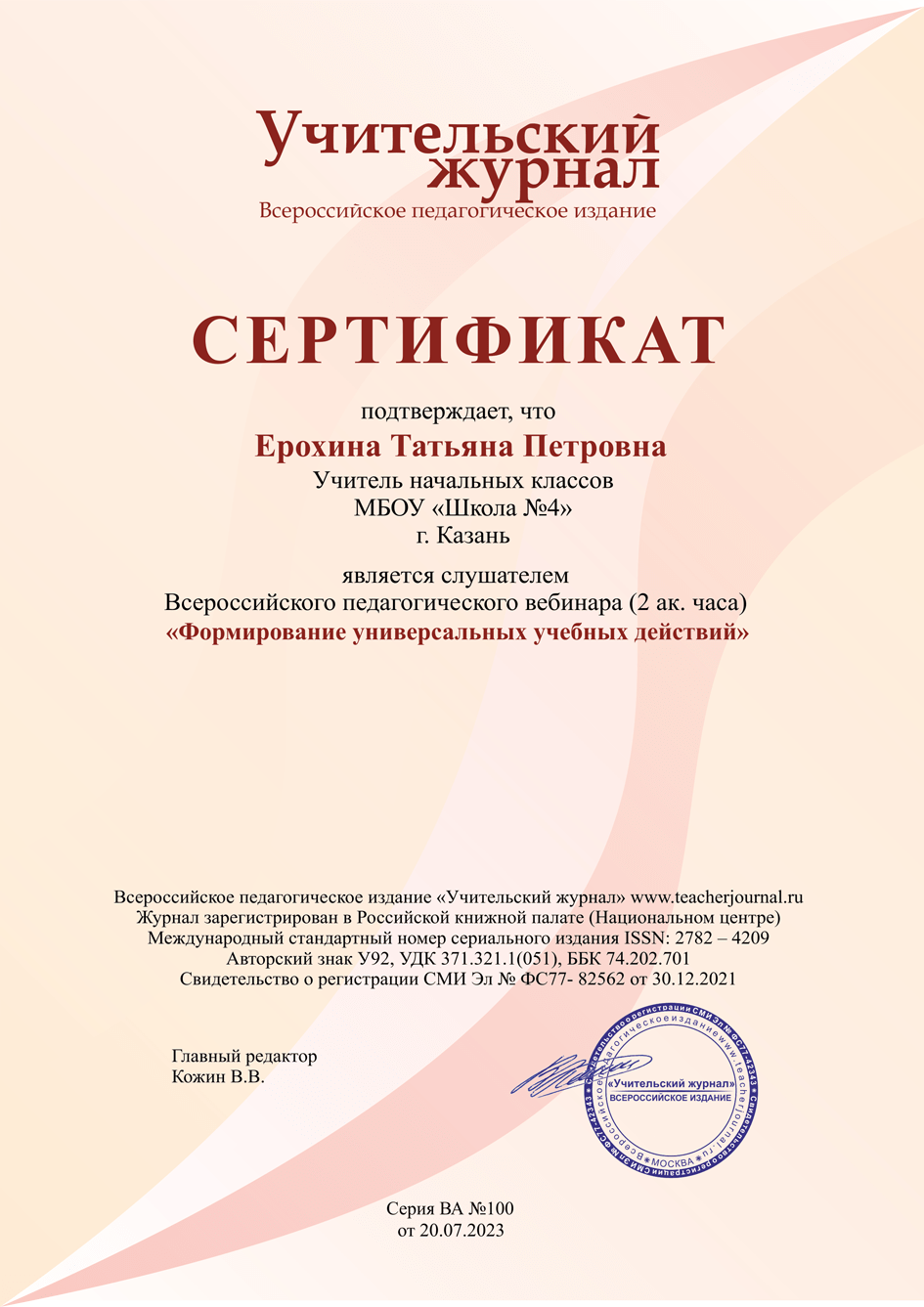
Сертификат слушателя вебинара
Регистрация в Федеральной службе по надзору в сфере связи, информационных технологий и массовых коммуникаций (Роскомнадзор)
Регистрация Российской книжной палаты, международный стандартный серийный номер ISSN: 2782 – 4209